
On 26 May 2026, CitiObs brought together over 50 participants from all over the world to participate in the online Citizen Science Dialogue - Using Citizen-generated Data on Air Quality for Better Health Outcomes. Organised as a roundtable discussion among leading experts from the field of air quality and health, the goal was to discuss how citizen science can contribute to reaching the shared mission of cleaner air for better health.
You can watch the full recording on our YouTube channel.
Showing the potential of citizen-generated data
The morning started with four framing presentations from CitiObs partners to set the stage. Núria Castell, CitiObs project coordinator from NILU, introduced how the project supports citizen observatories. Eline Verhoeven from the Netherlands National Institute for Public Health and the Environment (RIVM) highlighted the importance of collaborating with citizen observatories to make air pollution visible: “Citizens are already measuring air quality. They raise awareness, ask questions, and put air quality on the political agenda. We not only could, but should, make use of that potential.”
Philipp Schneider from NILU continued by showcasing methodologies developed in the context of CitiObs for automated quality control of citizen-generated data [1], which can be used for mapping air quality. He highlighted that exposure to air pollution varies geographically, and that official monitoring tends to be too sparse to capture local differences. This is a gap that Citizen-generated data can help fill to support policymaking, when used transparently and responsibly.
David Riallant from AirSentinels complemented the previous perspectives with showing how wearables can help individuals to measure their personal air quality exposure across locations and daily activities and – equipped with new information – can change their own behaviour and habits to improve the situation.
From data to relevant use cases and actionable pathways
The Roundtable was kicked off by Thomas Cole-Hunter, who joined wearing three hats: as Biosciences and Public Health director at EASAC - a network of (national) science academies in Europe; as technical expert in environmental health at UNICEF, and as visiting researcher at the University of Copenhagen. He came prepared with a proposed checklist across policy-application-research, which highlighted several important considerations when it comes to strengthening organizations' confidence in citizen science, starting from being clear about the use case for the data collected. He also underlined the importance of designing outputs relevant to specific stakeholders and that there should always be a plausible pathway to action stemming from the data.
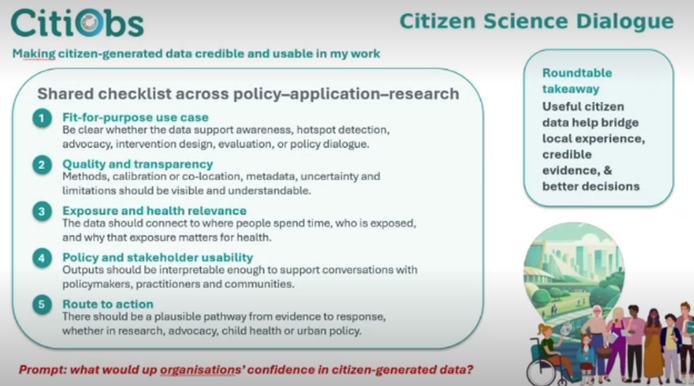
Shared checklist presented by Roundtable speaker Tom Cole-Hunter
The next Roundtable speaker, Pallavi Pant, Head of Global Initiatives at the Health Effects Institute (HEI) echoed Cole-Hunter’s inputs on the need for pathways to action and explained how her organisation is working on informing different audiences about air quality exposure. “We are trying to take very scientific information and make it more accessible and useful. In the context of this work, citizen-generated data has been of great interest.” She underlined the importance of pairing increased access to data with the right level of actionable information, so that we can get more people to talk about and lobby for clean air. We must avoid people feeling disenfranchised and resigned to the fate that they have higher air pollution exposure levels than they should have, but can do nothing about it.
The next Roundtable speakers - Dorien Dorresteijn, Senior Project Manager & School Coordinator from Globe NL and Jolanda van Rijssen, Senior Policy Advisor, Lung Foundation Netherlands – presented their organisations’ joint mission to create a healthy living environment with clean air for everyone. They presented their joint education programme called “Snifferbike Junior”, which raises awareness among school children and their parents about air quality and its impact on health, encouraging behaviour changes that contribute to cleaner air. Through 3 to 4 school lessons, pupils explore how air quality affects their lungs, how to measure it (using mobile sensors), and what they and their community can do to improve it. They highlighted how collaboration with the local authorities has been key to this initiative, especially when it comes to funding activities in schools.
Brief video about the Snifferbike Junior project
The next speaker Celia García Albertos, Architect & Urban Planner from the start-up Healthy Cities, presented the Healthy Cities Generator - a digital tool developed over more than a decade with support from the WHO and UN Habitat, designed to help cities understand and act on the link between urban planning and health. Based on scientific evidence, the tool analyses spatial characteristics of the urban environment and connects them to health indicators — from air and noise pollution to mental and physical wellbeing — to help identify priority actions and quantify their impact on both public health and economic savings. Recently, they have added a citizen engagement component to the tool, which helps to survey people’s perception about how healthy their surrounding environment is.
Key takeaways for policy and practice
In the discussion that followed, several key messages linking citizen science to policy and practice stood out. As CitiObs continues to strengthen its tools and policy recommendations, we take these with us into the project’s final phase.
- Citizen science is not only about data — it is also about awareness, trust, education, and action. When it comes to air quality and health, one shared goal is to get more people to understand, talk about, and lobby for clean air.
- Storytelling is an essential tool to turn data into relatable and credible information for different audiences.
As David Riallant reminded us: “Whenever you start with data, people will start questioning the data. If you start with a story, then you can empower people; they will relate, and then you can back up with the data”.
- Collaboration among pupils, communities, researchers, health organisations, and policymakers is needed to turn evidence into meaningful change. This requires a clear information pipeline for establishing how insights from data can lead to policy decisions and choices.
- Transparency, data quality, and pairing information from citizen-generated data with clear routes to action are key for building confidence in using such data. Market standards for sensing technologies are another factor that can lead to increased trust in and financing for citizen-generated data, for example through procurement.
There are some challenges that remain to be solved to fully untap the potential of citizen-generated data in policymaking and citizen-led actions.
- The cost of sensors is a barrier for citizen-led initiatives and schools that wish to design projects like Snifferbike Junior. And costs are not only for hardware, which only constitutes around 30% of the total costs of processing and communicating citizen-generated data. In one example highlighted from a CitiObs Fellow Case joining the dialogue, costs related to having devices registered and calibrated, implying an annual license fee, constituted a big challenge for their initiative. In the CitiObs Knowledge Platform, the Environmental Monitoring Toolkit guides people also through the process of planning the monitoring campaign, looking into these types of considerations.
- The Roundtable discussion also highlighted the risk for potential political backlash when data from low-cost sensors reveal problems that have not yet been recorded in official data (for example in data scarce contexts). In some instances, this can even lead to a ban on using low-cost sensors.
- In establishing a clear action pathway, we are faced with another inherent policy challenge related to air pollution: that of addressing the sources of pollution, which tend to be influenced by different policy areas, like for example transport and industry. In a position paper on air quality from 2022, Eurocities advocated for coherent revision of legislation aimed at air quality (e.g. the Revised EU Ambient Air Quality Directive) and legislation aimed at regulating sources of pollution. The paper further highlights the need to strengthen public information and involvement, where citizen science can play a positive role by giving people a voice and, as highlighted in the discussion, get more people to lobby for clean air.
On behalf of CitiObs, we want to once again thank all the participants and speakers for their time and dedication to the Citizen Science Dialogue.
Together, we can already form a strong group of lobbyists for clean air!
[1] The methodologies developed in the context of CitiObs have been published in two scientific journals:
- Evaluating the role of low-cost sensors in machine learning based European PM2.5 monitoring - ScienceDirect
- A scalable framework for harmonizing, standardization, and correcting crowd-sourced low-cost sensor PM2.5 data across Europe - ScienceDirect